Showing posts with label coffee and critique group. Show all posts

Wednesday, June 21, 2017

Review of LAUNCHING SHEEP AND OTHER STORIES FROM THE INTERSECTION OF HISTORY AND NONSENSE


Full disclosure: Sarah Angleton and I belong to Coffee and Critique, a weekly critique group which is also a chapter of the Missouri Writers’ Guild. Sarah gave me a copy of Launching Sheep & Other Stories from the Intersection of History & Nonsense in exchange for an interview, which can be found on my blog, Donna’s Book Pub, and a candid review of her book.

The following is my honest review:
Photo courtesy of
The Practical Historian blog

Published by Bright Button Press, Launching Sheep & Other Stories from the Intersection of History & Nonsense is a 288-page eclectic collection of more than 80 posts selected from Angleton's blog, “The Practical Historian.”

My first impression was the eye-catching dark cover and first few words in the title, which belie what's inside. Launching Sheep & Other Stories is neither a mystery novel, which someone commented they thought it was, nor is it a collection of dark tales about animal sacrifice or bizarre rituals from medieval times, which a quick glance at the cover might suggest. In reality, Launching Sheep is a selection of family-friendly blog posts with light-hearted glimpses of lesser-known historical facts and events.

Angleton’s blog posts collection begins in the spring of 2012, when she and her family are living in the Pacific Northwest. She wraps it up in the autumn of 2016, when they have moved to the Midwest. Earlier posts are peppered with parentheticals, which comment on or explain the previous text. As Angleton and her family relocate and she returns to her Midwestern roots, her posts take on a conversational tone without as many parentheticals.

Angleton’s book showcases her skills as a writer, researcher, and marketeer. Throughout her collection, she weaves family tales and historical happenings, along with touches of wisdom and wit. With a show of finesse and deft keystrokes on her laptop, she tells her family stories without being self-indulgent or self-congratulatory.

In her “Advance Token to Nearest Railroad” post which begins on page 68, she confesses to a competitive streak when it comes to the board game Monopoly. In “That’s How It Could Have Happened” starting on page 228, she shares her reaction to what might have been a ruinous accident that happened immediately before a neighborhood Christmas party. Hmm. That post also reveals historical facts about another popular board game; this time it’s about Clue, one of my childhood favorites.

Reading Launching Sheep is like sitting a kitchen table with a neighbor and listening to cherished stories about her family, kids, and adventures, as well as hearing quirky historical facts. What is evident throughout Angleton’s collection is that she is a loving wife, mother, daughter, sister, and friend. Also apparent is her talent as a writer and fascination with unusual historical characters and events.

Angleton gets bonus points for marketing skills with a brief preview of her upcoming historical fiction novel, Smoke Rose to Heaven, which appears at the end of this book.

Readers who have a soft spot for books with stories about family life or who have an interest in lesser-known historical happenings will enjoy Angleton’s book. I found it to be honest, informative, and entertaining. Especially attractive is the way the book is organized. Launching Sheep & Other Stories from the Intersection of History and Nonsense can be devoured from cover to cover or in short spurts, depending on which title captures a reader’s attention.

With an intriguing title and a set-up like that, what’s not to like?

Launching Sheep & Other Stories from the Intersection of History & Nonsense is available here. You can also read Sarah's interview about the book here.

Friday, February 3, 2017

Take Ten with J. J. Zerr, Author of "War Stories"

A big thanks to Coffee and Critique member, author J. J (Jack) Zerr, for agreeing to be featured on the Coffee and Critique blog. Jack is a hard-working writer who has published several novels. His most recent publication is a collection of short stories titled War Stories.  

In case you haven't guessed from the photo of him below, taken during one of our weekly critique meetings, Jack is a former pilot. His t-shirt states, "I love the smell of jet fuel in the morning."


The ten questions below are divided in three parts: background, writing, and publishing/wrap-up. 

1. First, a bit about your background. Before you started your writing journey, you had a distinguished military career as a pilot and an Admiral in the U.S. Navy and a consultant in private industry. Can you briefly share your thoughts about that experience?

A.    I was shanghaied into the US Navy by my father. I did not want to be a sailor, but Pop said the Navy might teach me something. He took me to a recruiter, said sign here, and I signed. Life as a junior enlisted man was not fun. I got seasick and planned to get the crap out of that outfit as soon as I could. But, I took a test for a Navy college scholarship program, and lo and behold, I scored well on the test and went to Purdue for a BS in electrical engineering. Also when I went in the Navy, I was going steady with a high school classmate. She went to nurse’s training when I went to boot camp. I thought she’d meet a doctor, and that I’d find out about it via a “Dear John.” But as it turned out, half way through Purdue, as an E-5, I had the wherewithal to ask her to marry me. So it turns out Pop was right. The Navy educated me. And I was wrong. The service didn’t get me a Dear John, rather, the Navy enabled Karen and I to give each other “I dos.” Vietnam happened, I went on to hold five command positions, including an aircraft carrier, and was lucky enough to retire as a rear admiral. Overlaying that, Karen and I had six children, and we lost a preemie in 1969. If I had picked my own way after high school, God only knows what I’d have turned into. Maybe He doesn’t even want to think about it. If I had really gotten that Dear John, I don’t know. I’d have been unborn off the earth, or it would be “Better for me to have had a millstone tied around my neck and cast into the sea over the Marianas Trench.”

Brief you said. Sorry about that.

2. During your military career you traveled around the world. What are some of your most memorable experiences or the unforgettable places you’ve been?

A.    Number one, San Juan, Puerto Rico. It was the first port outside the US my ship visited. Guys from the electronics technician shop I worked in took me to a bar, where as long as one person in the group was of age, we got beer. The bar had girls. The girls were friendly. The guys from my shop wanted to buy some friendship for me, but I got up and walked back to the ship. It was, to the guys in my shop, some sort of initiation ritual. It would make me a regular guy, I guess. But I saw it as a cliff. After twelve years of Catholic school, if I worried more about those guys accepting me than what I’d been taught, it would have been like throwing away the first eighteen years of my life. Ever since then, I have been suspicious of group think, the prevailing sense of right and wrong, PC, these days. Perhaps San Juan is a big reason I list Shane, Hondo, and The Oxbow Incident at the top of my all-time favorite books.

3. Now, onto the questions about writing: What has been the biggest influence on your writing (e.g. a teacher, your family, your faith, your military experience, none of the above, all of the above???)

A.    First, Sister Mathew, lit teacher in high school. Through her, I encountered my favorite short story: The Short Happy Life of Francis Macomber; my favorite novella: The Old Man and the Sea; and my two favorite lines of poetry: “The tintinnabulation of the bells”, and “You may contribute a verse.” And I have always loved to read. My wife says I was born with a book in my hand. If I was, when the doc held me upside down and smacked my bottom, I bet I yowled but did not drop the book. And Sister inspired in me the desire, to one day, write a book of my own.

4. How did you get started on your writing journey?

A.    See above. And in my junior year at Purdue, I found an ad for a Writer’s Correspondence Course. We really couldn’t afford the fee, but my new bride said it was okay to spend the money. I completed the course and carried the materials around with me through twenty-five moves. When I was in the Navy, I worked at being in the Navy. When I worked in aerospace, I worked at being an engineer and a manager. I retired from that line in 2007, and on January 2, 2008, I began work on my first novel. Ted Koontz worked his day job and wrote his poetry at night. God bless Ted for the verses he contributed. Me, I couldn’t really start writing until I could do it full time.

5. What is your favorite aspect of writing? What is your least favorite aspect of writing?

A.    I love it when an idea for a story comes out of wherever they come from. The book I
am working on currently is called Guerilla Bride. I have a CD with a collection of Civil War songs on it. One of the tracks is about Kate Quantrill. That song inspired the story. The story, by the way, began life as a short story. I packaged it along with some others and sent it off to my publisher early last year. In the first review, the editor suggested I turn the Civil War story into a novel. Whose advice I took and which I am close to finishing. Which is why War Stories was delayed a year.

My least favorite aspect is finishing a story. Two reasons actually: one is after an intimate involvement with a cast of characters, they aren’t mine anymore after publication; Two I experience a bit of a lost feeling after having lived in a world of my manufacture for a long time, and suddenly, the world just isn’t there anymore. It lasts a couple of days; then other stories start yammering to be turned into ink on pages.     

6. How has belonging to a critique group helped your writing?

A.    I’ve said this a number of times before, but the best piece of writing critique I’ve ever gotten was from Lou Turner. I brought in a story, which was about a Navy pilot who was the new guy in his squadron and he was anxious to not be the new guy anymore. I had a scene set in an O Club bar. After I read my scene, Lou said, “I gotta tell you. I didn’t like it at all. It’s just another stupid guys drinking in a bar story.” In my mind, I was telling the story I wanted to tell, to my reader, Lou, however, I told an entirely different story. After my fourth novel came out, a classmate of mine from Purdue wrote to tell me he liked The Happy Life of Preston Katt. Then he went on to say, “your writing is better when you are not writing about yourself.” I had to think about that a bit, but I believe I see what he was telling me. I think I get into my characters, the good guys, the bad guys, the bit players, and I think you have to do that, but you also have to be a little bit god, and stand above all the blood, sweat, and tears, detached enough so you can see if your readers will feel and smell and hear what the character senses. For me, the Coffee and Critique group has been powerful in helping me develop a sense of reader perspective. I hope I never let myself believe I’ve learned all I need to about this subject.

7. Now, for publishing: You’ve published several successful novels, but War Stories is your first collection of short stories. Why did you decide to compile these stories and what can you tell us about the collection?

A.    My first two novels were each three-year projects. When I put them out for editing or review, I worked on other things. I wrote stories to submit to contests and for consideration of inclusion in anthologies, and all of those were to expose my work to a wide range of readers. I never submitted to contests unless they promised feedback. Some of these stories wind up as scenes or chapters in the novels. The bar scene mentioned above, for instance, wound up, modified, in my fifth novel, The Junior Officer Bunkroom. I decided to compile them into a book because I had accumulated a sizeable collection of short pieces, and I thought, what the heck. I looked at them all and tried to find a theme. The theme really came from the first story in the book, “What Kind of Man are You?” The main character, Joe Bob, in a sense, is a bulldozer plowing over people and obstacles to get a job done. He’s in the military in the beginning of the story, but in the military, even bulldozers have commanding officers. He’s booted out of the Navy. But Joe Bob’s philosophy is: “Do not let your chin drop. Find a way. Keep going forward until your heart stops, your eyes go dim, and you fall off your legs.”

People say, “Life sucks, then you die.” Which is pessimistic, dark even. Joe Bob does not allow the slings and arrows of outrageous fortune, the vicissitudes of life show him even a glimpse of the dark side.

Life is full of struggles, wars even, and not just between nations.
Gender, age, technology, acceptance, political correctness can all be battlegrounds. The characters in my stories, for the most part, are more like Joe Bob than the life sucks crew.


8. Do you have a favorite story in the War Stories collection?

A.    That’s like saying which one of your daughters is the most beautiful. Well, not quite. Anyway, one of the things I tried to do with these stories was to try different narrator voices. And I am satisfied that I did that. I guess I like “Forwards.” I think I’ll just leave it at that.

9. After publishing five novels and a short story collection, what lessons have you learned about writing, editing, and the publishing process?

A.  I’ve read books about character, plot, tension, showing instead of telling. I attended a writing weekend in New York a couple of years ago, and got critiques from eleven big city folks and the instructor (a Californian.) But more importantly, I think, I’ve been writing every day, almost, since January ’08. I think I learned a lot. I like to think my writing has and is improving every time I get the keys to clickety clacking. But it doesn’t make it easier. It still is harder than work to get things as right as I can make them. A worthy editor is worth her weight in pearls. (Most of them are female, although I have found one male at my publisher who is very good on structure. Editors are vital, in my mind, not only for structure and grammar and spelling and word choice, but checking historical facts as well, and catching the use of modern terminology in a time setting before the terminology was invented. I love editors. I self-publish. I like the control I have over the process. I like the editors the publisher uses, and they have publishing packages, ranging from simple publishing to publishing plus levels of publicity. I’m comfortable with them. They are comfortable with the money I pay them.

10. Any final thoughts you’d like to share?

A.  Just thanks for the blog.

You can learn more about Jack and his books here.


Wednesday, June 1, 2016

Coffee and Critique Has a New Policy to Save Trees

Summer time and the readings are easy at Coffee and Critique. Many of our members take some time off for vacation, so we might only have six or seven attend rather than our usually 10-12. Although, it's also the time when teachers on vacation drop in to read their works-in-progress.


This week we started a new practice to conserve paper and ink and ultimately save a tree. The one on the left split open after being struck by lightning at our country place last year.

The day before our critique group, I'm going to send out an e-mail with a roll call so readers will know how many copies to bring rather than printing the standard ten copies we usually bring.

"Great idea!" "Brilliant!" Are some of the comments uttered after our new policy was announced.

Hope you're staying busy writing, and when you get the chance, try
to save a tree.

Thursday, November 5, 2015

Coffee and Critique Member Marcia Gaye's Work on Display in St. Peters

Marcia Gaye's Display at
St. Peters Cultural Arts Center
Award-winning writer Marcia Gaye, shown at left, is a prolific member of Coffee and Critique.

Her poetry, short stories, articles, and essays have appeared in a wide variety of literary and commercial publications.

Marcia recently had the opportunity to display more than a dozen books containing her work at the City of St. Peters Community and Cultural Arts Center.

You can check out Marcia's eye-catching display at the City of St. Peters Community and Cultural Arts Center. 1 St. Peters Centre Blvd.(at City Hall), St. Peters, MO 63376. Phone: 636-397-6903.Her work will be on display until the end of 2015.

The hours of operation are: 

Monday-Thursday, 9 a.m.-9 p.m.
Friday, 9 a.m.-5 p.m.
Saturday, 9 a.m.-4 p.m.
Sunday, Closed

Congratulations, Marcia. Way to represent!

Thursday, May 28, 2015

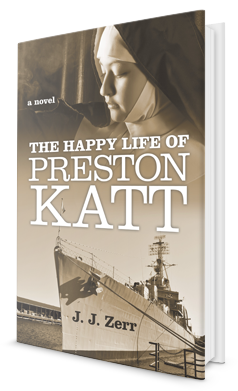
Just Released: J.J.Zerr's Historical Novel: THE HAPPY LIFE OF PRESTON KATT

Coffee and Critique long-time member Jack Zerr has released his latest novel: The Happy Life of Preston Katt.

Not only is Zerr a talented writer, he also is very generous. He recently presented members of Coffee and Critique autographed copies of his novel. Once I began reading my copy, I had a hard time putting it aside.

Zerr's historical tale opens on the Island of Oahu on December 7, 1941, "a day that will live in infamy."

After a night of reckless abandon, Seaman First Class Preston Katt sneaks back aboard the USS Callahan scant hours before the Japanese attack Pearl Harbor.

Preston Katt's naval service began right after high school graduation. He joined the Navy to escape his alcoholic and neglectful mother and to leave behind painful memories of growing up in the fictional town of Saint Ambrose, Missouri, where the only kindness he was shown was by his beloved teacher, Sister Ralph, and the charitable and warm-hearted shopkeeper, Frau Grossman.

In the Navy, Katt has found a new home as a sailor serving on lookout duty during the heat and chaos of the war in the Pacific. Katt has a unique talent. Using his favorite pair of Navy-issued binoculars, Katt's eagle-eye vision is responsible for spotting enemy warships and planes far away, saving several US vessels from being destroyed.

As the story unfolds, we learn about the daily grind of Navy life, as well as Katt's struggle with guilt and insecurities and his strong and sustaining faith.

As a Navy combat aviator, Zerr writes with authority and compassion. His  vivid writing, strong characterization, and attention to detail make The Happy Life of Preston Katt a compelling read.

Wednesday, May 6, 2015

An Announcement and a Call for Submissions for Veterans and their Families

It's official, Coffee and Critique writers' group is the newest chapter of the Missouri Writers' Guild. Watch for details in a future post.

Here's a call for submissions with a short deadline.

With so many veterans and family members of veterans in Coffee and Critique, I thought this call for submissions would be of interest to them and any other veterans or families of veterans.

But act fast, the deadline is June 1.

For all military personnel, Veterans, and their families:
Call for Submissions for Proud to Be: Writing by American Warriors volume 4
Deadline: June 1, 2015
No fee
Prize: $250
Categories: Short fiction, Poetry, Interview with a Warrior, Essay, Photography
Writing must be by veterans, military-service personnel or their families.  Include the connection in your short bio.
Theme:  Created by the Missouri Humanities Council, the Warrior Arts Alliance, and Southeast Missouri State University Press, this series of anthologies preserves and shares the military service perspectives of our soldiers and veterans of all conflicts and of their families. It is not only an outlet for artistic expression but also a document of the unique aspects of wartime in our nation’s history.

For more details, click on this link.

Tuesday, November 11, 2014

Thanks to our Coffee and Critique Writers' Group Veterans

Thanks to all our Coffee and Critique writers' group veterans, past and present.Thank you for the sacrifices you have made so the rest of us can enjoy our freedoms.

The following is the roll call of US Veterans who belong to Coffee and Critique writers' group who have honored us with their words, their wit, and their wisdom:


Nick Nixon (USMC, deceased)
Doyle Suit (US Army)
Bill Mueller (US Army)
Jack Zerr (US Navy)
Charles Rogers (USAF)
Les Thompson (US Navy)
Lonnie Whitaker (US Army)

Without your service we wouldn't be able to enjoy the liberties at our critique group, including:

* The right to assemble (every Tuesday for two hours and sometimes for lunch afterwards).

* The right of self-expression during our critiques (as long as they don't exceed two minutes).

* The freedom to write without fear or intimidation, (as long as we don't exceed our five, double-spaced page limit with one inch margins all around in Times New Roman or a similar font). ;-)

* The right to read our works and receive generous feedback from everyone present.


Friday, October 31, 2014

Opinion Shaper Alice Muschany

Coffee and Critique writer Alice Muschany is always on the go, what with her new farm, eight grandchildren, taking care of family members, and other responsibilities, yet she still takes time for writing.

And she always does a wonderful job!

Here is a link to another one of her humorous Opinion Shaper columns: A Care Partner for the One I Care About.

The description of Nurse Brenda and "Hospital Secret Service" quip are
great!


Wednesday, October 29, 2014

Ghostly Tales at Coffee and Critique

Yesterday's Halloween story session was entertaining and lots of fun!

Everyone had a unique take on the topic, and everyone who attended read. One person who couldn't make it e-mailed a story, which I believe will be read next week.
Once again, the guys outnumbered the gals. This time it was 5:3.

Here's a glimpse of what was read;with titles like these, how could we not have a good time?

"Social Guy," a cat fight and a cat with special powers.

"The Crime of my Life," a humorous glimpse about working at a crime lab in Springfield, Illinois.

"Voodoo Barmaid," a guy walks into a bar and strange things happen.

"And the Dead After All are Not Hungry," a touching Halloween story about love and loss.

"Halloween," a mysterious woman, a graveyard, a love potion, and a tombstone.

"Elixir of Life," a magic potion with life-altering properties. Where can I buy some?

"The Ghost of Chateau de Chasse," a family moves in to a Belgian castle, where they're not the only residents.

"Yankee Doodle Dead," the ghost of a Yankee soldier haunts a Missouri family.
.

Wednesday, September 24, 2014

Doyle Suit and Baker Mountain Featured in the Montgomery County, Arkansas, News

During last Tuesday's Coffee and Critique session, Doyle Suit shared some exciting news about his recent book signing.

Last weekend Doyle returned to his roots in Mount Ida, Arkansas, for a signing and discussion at the Montgomery County Library of his YA novel, Baker Mountain.

Suit's YA novel, Baker Mountain, is a story about Gary Hill, a 17-year-old sent to live with his grandparents in Arkansas' Ouachita Mountains during the Great Depression.

Doyle's Mt. Ida connection and novel resonated with many of the locals who visited the library for his discussion and signing -- because Doyle sold out of books!

In addition to his appearance at the library, Doyle and his book were featured in the September 18 edition of the "Montgomery County News."

Congratulations, Doyle! We're all proud of you and your many accomplishments!

Tuesday, September 9, 2014

Fall Back into the Writing Habit

Glen, Les, Bill S., Jane, Lou, Jack, Sarah, Mikey, Donna, Doyle
Hey, writers, what time is it?

Time to fall back into the writing habit.

Fall hasn't officially arrived yet--although you could fool me with last night's beautiful Harvest Moon.

Now that summer is winding down, vacations are over, and the kiddos have returned to school, more members of Coffee and Critique are showing up each week.

Today, a dozen writers showed up despite the lovely weather when they could've been outside.

In addition to the nine writers above (along with Mickey from the Rendezvous Cafe popping in for the photo with the rest of the gang), Alice, Bill, and Charles attended critique but weren't able to stay for lunch.

And, although we only had two readers, we had lots of announcements and news before we began. We also gave thorough critiques to the two brave souls who read. The atmosphere was fun as Lou restrained order by having the guys swap places and sit among the women.

A fun time was had by all!


Sunday, June 15, 2014

Take Ten with Stan Wilson - Inventor, Grant Writer, and Entrepreneur

Stan Wilson has belonged to Coffee and Critique for several years. Many of his stories are set in southern Indiana, but others occur in out-of-this-world locations. Members of Coffee and Critique especially enjoy Stan's stories with strong science fiction elements, about which, he tell us, "the science part is true." He contributed two stories to the Coffee and Critique Anthology: "Whiskers and Whispers" and "Do-It-Yourself Fishing."
Stan grew up in humid southern Indiana, the land of beautiful hardwood forests, limestone cliffs with bubbling creeks and thousands of caves with hidden rivers and buried caches of gold or secret hordes of confederate treasures so some say. In college, he studied physics, electronics and engineering leading to a career as an entrepreneur, inventor and design engineer, often as the manager of the manufacturing firm producing his designs.

Married, with two grown sons, he enjoys writing for fun along with his many hobbies which include amateur radio, MG cars, model boats and airplanes.
Here are Stan's answers to the take ten questions:

1. What or who inspired you to become a writer?

 I really have no idea. I have written technical articles for DIY newsletters for years.

 2. What is your writing specialty?

Non-fiction grant and proposal writing -- developing creative solutions to complex design problems.  This is a total reversal from writing fiction.  A money-winning grant is written in first person and present tense. I take great pride in that over the years my grants and proposals have resulted in employment for several hundred people including myself.  

3. How would you describe your writing process?

My stories are always visible in my mind before putting them on paper. The same is true when I am designing a product. The story difficulty occurs in putting them on paper. The designed products sometimes lose my interest because they are already ‘real’ in my mind.

I spend a portion of ever day either in my writing attempts or inventing. Writing is more difficult.

Others might consider both are my hobbies.

 4. What is the best part of being a writer? The worst part?

The best part for me is seeing and feeling my characters come alive on the page.

The worst part about writing is I’ve had to learn enough English to convey my story to others.

5. What is the best writing advice you’ve received?  The worst?

The best advice came from Nick Nixon who told me to listen for the story’s beat and to make it happen.
The worst advice, psychological, was from those who have told me I am wasting my time. But writing to me is like my dad’s fishing. Dad always said one didn’t have to catch fish to enjoy fishing. I don’t have to write a novel which will become a famous movie; I only need to enjoy the conversations with my characters as I tell about them on the paper. 
6. Which books on writing you can recommend for other writers?

In my case they are English manuals, both available in the used books on Amazon.com for about a dollar.

William Strunk and  E.B. White “The Elements of Style”

“Plain English Handbook”  by J. Martyn Walsh and Anna Kathleen Walsh.

 7. How has belonging to Coffee and Critique benefitted you?

Critiques are tough; however, they do improve one’s stories. At least I now know the difference between adverbs and adjectives. I still get my subjects and objects reversed and I hate writing in past tense.

On the social side, I have met many interesting and nice people via the C&C.

The fastest two hours of the week are those spent attending the critique.

8. If you’ve been published or have won awards, which are the most special to you?
 Five of my stories have been published in anthologies.

It is a toss-up on which of them, I like the best. “Bloody Good Da’ For a Picnic” was pure fiction, and I still feel the emotion when I read it, which I felt when I wrote it. The other one is a true story. “Tomorrow at Five” was fun to live and fun to write about.

9. What three words best describe you?
 Imaginative (I always think outside the box), have a sense of humor, and stubborn.

10. What are you working on now, and/or what is your writing dream?

I am cleaning up many of the stories I have written over the past four years. My goal is to get them to an editor by the end of this year and self publish.

Bonus question: If you could interview one or two famous writers or historic figures living or deceased, who would they be and what would you ask them?

I would love to have a conversation with author, Jules Verne from the 19th century. He was at least two hundred years ahead of others in his view of what the engineering world would become in the future.

It would be a thrill to talk to, Dr. Nikola Tesla, the world’s greatest inventor for even an hour. He invented our power grid with allows us to light up the world.  He invented the electric motor and generator. He even had a remote control boat before wireless or radio existed.

I often wonder, if men like them were actually time travelers.

Finally, is there anything you’d like to add?

I believe to become a great writer one has to be driven at a young age to learn the skills required which are many.

Thanks, Stan, for your insight into your writing process and thoughts on writing and life.


Friday, May 2, 2014

Take Ten with John "Jack" Zerr - Pilot, Poet, and Published Author

Jack has been a most welcome addition to Coffee and Critique for several years now. He brings his wisdom, wit, and vast military experience to the table. Everyone in the group appreciates his writing talent, big-picture critiques, willingness to learn, and his humility. 

Most of all we appreciate the sacrifices he has made on behalf of our country. That's why we make it a point to tell him, "Thank you for your service!"

Here is Jack's bio:

John Zerr, US Navy rear admiral (Retired). US Navy pilot, and Vietnam veteran. 320 combat missions flying the A-4 Skyhawk. During his thirty-six year career, he accumulated 1017 carrier landings. Most memorable Navy assignment: commanding officer of the aircraft carrier USS Constellation (CV-64).

After leaving the service, he worked for a major aerospace company for eleven years.

Author of poems, short stories, and three novels: The Ensign Locker, Sundown Town Duty Station, and Noble Deeds. He and his wife, Karen, live in St. Charles MO.

Web site: www.authorjjzerr.com

Here are Jack's answers to the Take Ten Interview Questions:

1. What or who inspired you to become a writer?

I had a high school English/Lit teacher, Sister Matthews. On my mid-semester report card, junior year, she gave me an “F.” I went to her and said that I should have gotten a “C.” “No,” Sister said, “you should have gotten an ‘A.’ For the semester you will either get an ‘A’ or another ‘F.’”

One of her requirements was writing five pieces ranging from science to fantasy. I got a “B” and a hankering to write things from Sister. 

2. What is your writing specialty?

Fiction.

3 How would you describe your writing process?

On longer work, I outline. I have self-published three novels, and my outlining process, I tell myself, has matured from book one to number three. I will say, with the outline of the first novel, the only part of the outline that stayed the same from project launch to completion was the ending. I revised the outline a number of times when the writing process disclosed narrative strings that refused to weave together. I must have tried one hundred beginnings on the first one before I finally settled on one to go with. I have been writing seriously for six years now, and I think I have developed an ability to envision story structure for shorter pieces without a formal outline. Bottom line, my process is to plot the story before starting to write.

4. What is the best part of being a writer? The worst part?

The best part is getting an idea for a story. The worst, the absolute, totally sucks, part is finishing a book-length work. I get wrapped up in the characters, the problems they face, and I hate to let them go. It feels like a funeral.

5. What is the best writing advice you’ve received?  The worst?

I’ve said this before, but in my first year with C&C, Lou said, “Your story is just a stupid men-drinking-in-a-bar story. I’m just not interested.” Which prompted me to revisit the question, “Whom are you writing for?” Which I hadn’t really answered properly for myself. It was frank, to the point, and majorly true.

I don’t consider any advice I’ve gotten bad. Some I don’t agree with, but I always think about every input I get. Even advice I totally agree with, I try to find other thoughts that spin off the original input. Good writing is harder than work, at least any work I’ve done before. My brain is majorly limited, so I am happy for every bit of critique that comes my way.

6. Which books on writing you can recommend for other writers?

I don’t have books on writing to recommend, but I do have a couple of books that I think are worthwhile to read for learning about writing. Eudora Welty’s The Optimist’s Daughter, and James Baldwin’s The Fire Next Time. I recommend reading them more than once.

7. How has belonging to Coffee and Critique benefitted you?

Coffee and Critique has been the world to me as a writer. Submit five pages to our group, and by the time the piece circles the table, it will be better, I don’t care how good it is at the start.

8. If you’ve been published or have won awards, which are the most special to you?

I published my third novel, Noble Deeds, in November, 2013. It is set on an aircraft carrier.

I had a poem published in Writer’s Digest 7th annual poetry competition. My input was chosen as number 10 out of 2000 + entries. That was cool.

9. What three words best describe you?

Lucky, blessed, short.

10. What are you working on now, and/or what is your writing dream? 

I am working on collection of short pieces, some of which, in my mind at least, are funny. Plus I am getting close to finishing a first draft of a fourth novel, a piece of historical fiction set on an aircraft carrier in 1971 deployed to Vietnam.

Bonus question: If you could interview one or two famous writers or historic figures living or deceased, who would they be and what would you ask them?

What I wish is that I could have been at the Sermon on the Mount. I would have liked to hear the words (in English, please). My mouth would probably have been hanging open. It wouldn’t have been able to ask a question.

Finally, is there anything you’d like to add?

I have a website at www.authorjjzerr.com


And yes, ma’am, thanks.

Thanks for your candid and insightful interview, Jack.

Note: You can listen to Jack talk about his inspiration for Noble Deeds on YouTube


Thursday, March 20, 2014

Take Ten Interview with Coffee and Critique Co-founder, Donna Volkenannt


Continuing with the Take Ten interviews, next up is Coffee and Critique co-founder, Donna Volkenannt. 


Donna is a writer, an editor, and a creative writing teacher whose stories, essays, reviews, and interviews have been published in hundreds of print and online publications. 

Her work has been recognized with more than 100 awards. She recently received notice that her true story "Remembering Miss Tobin" was a top ten finalist in the 2014 Erma Bombeck Global Human Interest writing competition category. In 2012, her true story "Honey, Can I Borrow Your Garter Belt?" won first place in the Erma Bombeck Global Humor writing competition category. 


Here are her take-ten questions and answers, which also appear in the recently published Coffee and Critique anthology:


1. What (or who) inspired you to become a writer?

My parents and the nuns who taught me in school.

I grew up the middle child of seven, surrounded by storytellers. Mom’s family were Baptists, originally from the Little Dixie area in and around Hannibal, Missouri. When we got together with her “relations,” the women swapped gossip, shared recipes for things like calves’ brains, and talked about their superstitions, especially when one of them had a dream of muddy water – a sure sign someone was about to get sick or die. Dad grew up in North St. Louis, in a large Irish-Catholic family. He served in the Army infantry during World War II. When we got together with his brothers, they drank a lot of beer, told stories about their wild childhood, argued about who saw the most time in combat, and whose first name was the most Irish. Those family memories have been fodder for my stories and essays. As a child I loved to read, and the nuns who taught me encouraged me to write.

2. What is your writing specialty? 

Good question. I write where my ideas take me and like to experiment with different genres.

3. How would you describe your writing process?  

I jot down ideas, snatches of conversations, titles, outlines, and such in a notebook or on scraps of paper. I believe there is a connection between the physical act of using a pen and writing on paper. When I begin to write a first draft I consult my notes as I type on my laptop, but the words seem to flow because I’ve already connected physically with my story or essay. Usually, I write several drafts then let my manuscript sit for some time before bringing it in for critique.

4. What is the best part of being a writer?  What is the worst part of being a writer? 

The best part is when I’m in the “zone.” It’s an almost spiritual experience when the words flow from somewhere deep inside. It’s magical when I write something then wonder, “Where did that come from?”

The worst part is not having time to write and losing focus.

5. What is the best writing advice you’ve received? 

Two memorable pieces of advice given to me from other writers come to mind.

The first occurred several years ago during one of my first work-in-progress readings. When I finished, I apologized for my work not being well written. Afterwards, an older gentleman said that he liked my story and encouraged me to keep writing. He told me, “Don’t hide your lamp under a basket.”

The second came from the late Nick Nixon during a critique group session. After I read a personal essay, Nick told me to put more emotion into my work and to not hold back. He wrote on top of my essay, “Take your gloves off.” When I got home I misread what he had written as “Take your clothes off.” His advice was inspiring and turned out to be humorous as well.

The worst?

“You need to change –  ” which messes with my writing voice. Equally harmful is when someone else tries to impose his or her sensibilities on my work. I’ve learned to ignore remarks suggesting I “need to change” parts of my stories or essays because they are too religious or too Catholic.  Just like a writer’s unique voice, a writer’s personal beliefs should be respected and left alone.

6. Which books on writing can you recommend for other writers?

My shelves overflow with books on the craft of writing. The fundamentals are: Elements of Style by Strunk and White, On Writing Well by William Kinser, On Writing by Stephen King, and Good Prose by Tracy Kidder and Richard Todd. I also have a large stack of college-level literature textbooks which contain short stories and essays from esteemed writers. Finally, I recommend reading books in the genre in which one wishes to write.

7. How has belonging to Coffee and Critique affected you as a writer?

Meeting once a week keeps me focused and energized. There’s no feeling like being around other writers to spark my creativity. I also have made several writer friends whose wisdom and encouragement are golden. No matter how much I revise and polish my manuscript, it is always made better after bringing it in for critique. The writers in Coffee and Critique are worth their weight in gold -- and ink!

8. If you’ve been published or have won awards, which are the most special to you?

The most special are two true stories about my late children. “Julie’s Gift” in A Cup of Comfort for Women is about the lesson of selfless giving I learned from my late daughter Julie while we were living in Germany. The second, “Santa Wore Cowboy Boots” in A Cup of Comfort for Christmas, is a true story about a lesson my late son Erik taught me about the real meaning of Christmas when we were living in Arizona. 

9. What three words best describe you?

Never stopped believing.

10. What is your writing dream? 

To finish the projects I’ve already started and continue coming up with ideas for more.

Bonus question: If you could interview one or two famous writers or historic figures living or deceased, who would they be and what would you ask them?


I’d interview Missouri writers Mark Twain and Kate Chopin. 

I’d ask Mark Twain what it was like to live in Missouri at the time of the Civil War. I’d also ask if he knew any of my maternal great-grandparents, who lived in Hannibal the same time he did.

I’d ask Kate Chopin how writing helped her overcome her grief after the loss of loved ones, and what it was like living in St. Louis during the 1904 World’s Fair.

Find more about Donna on Donna's Book Pub, where she blogs about writing, publishing, books, and the sweet mysteries of life.

Friday, December 20, 2013

Cover Reveal: Coffee & Critique Anthology

Here's a sneak peek at the front and back covers of the soon-to-be published Coffee & Critique anthology.

This first issue of the anthology includes short stories, essays, and interviews from more than a dozen writers, all associated with the Coffee & Critique group that meets each week at the Rendezvous Café in O'Fallon.

Check back for details about the book's official release date.

Thursday, October 31, 2013

Take Ten with Lou Turner, Co-founder of Coffee and Critique and CEO of High Hill Press

Lou Turner is an unforgettable woman who wears many hats. As co-founder of Coffee and Critique, she dispenses candid and unvarnished suggestions to help writers become better at their craft. 
In 2008 Lou and her husband Bryan started High Hill Press.

High Hill is not a self-publisher or a vanity press, but a small publishing business to offer writers a small niche between the huge New York publishing houses and the often high-priced print on demands.
 
Since becoming CEO, editor, and publisher of High Hill Press, Lou has nurtured scores of writers in navigating the publishing process to turn their writing dreams into reality.

Along with her team of five acquiring editors, Lou takes a personal interest in any book published by High Hill. While High Hill is a small press, it stresses quality in submissions. Only 25% of submissions are accepted for publication.
 
Lou took time from her busy schedule to respond to the "Take Ten" interview questions:
 

1. What inspired you to become a writer?

Lou: It has to be my childhood. Mystery author, Agatha Christie, said in the introduction to her autobiography, “One of the luckiest things that can happen to you in life is, I think, to have a happy childhood.” When I first started writing my parents were my only readers. I thought I was creating fiction, but every time my dad read one of my short stories, he would say, “I didn’t know you remembered that.” So between alligator wrestling Uncles, a grandpa that gambled for Al Capone, and everything in between, I’ve never had to grasp for something to write about.
 

2. What is your writing specialty? 

Lou: I’m not sure. I hate it when I hear an editor or agent telling people to stick to one genre. How boring would that be? I like to stretch and try new things and new styles when I write. I love the “what if” game. What if Scarlett O’Hara found her beloved Tara overrun with Zombies? Wow, that would be a great story…guess I’d better get busy on that one.
 

3. How would you describe your writing process?  

Lou: I used to challenge myself and sit in front of a blank screen to see if I could come up with something new, something I’d never thought of writing before. Now I just wait until an idea comes to me and head to the computer. Recently I was told to write about a specific topic. And although it was a great topic, I found it hard to work like that. My most recent essay is called The First Gray Hair, and I wrote it after a younger woman commented that older people are often behind the times. Anger, I found, is a great place to start when writing an essay about aging. The actual process is constantly changing for me. I don’t feel as though I have to write every day to accomplish what I want, but there are times when I will literarily write for 8 or 10 hours a day for days on end. I’ve worked many times right through the night.
 

4. What is the best part of being a writer?  What is the worst part of being a writer? 

Lou: Best: It’s all good. But probably just knowing each time you start a new project that your brain is still able to work is the best.

Worst: Having a great story rumbling around in your head and not finding the time to get it down before it flees.


5. What is the best writing advice you’ve received?  The worst?

Lou: Best: Just write. If you come to a dead end in one story, start another one.

Worst: I’ve probably never had any really bad advice. I can always tell when someone comments about my writing whether they’re doing it from a place of real helpfulness, or whether they’re just throwing out advice to be throwing out advice. I’ve learned to know the good advice from the bad…and I ignore the bad. I did have an editor put a zillion semi-colons in an article I’d written for a newsletter once. She didn’t discuss it with me, just plopped then in all over the place. It turned my humorous and conversational article into something unrecognizable. Which made me realize how dangerous a bad editor can be.


6. Which books on writing can you recommend for other writers?

Lou: Reading is the best advice I can give you. Buy all the writing guides you can pick up off the sale table and keep them at your fingertips for when you run into a specific problem…like grammar or punctuation. But for learning how to write and develop your voice, you have to read the work of authors who did it well.

I started reading before the first grade. I grew up on Mary Shelley and Charles Dickens, and then Flannery O’Connor and Eudora Welty. I don’t read as quickly as I used to, but I keep a book with me all the time. What amazes me now is that I can read a good book and see why it’s good. I can see how the author put just the right amount of imagery in his prose. How he put suspense in just when it was needed. How his dialogue flows, or sometimes doesn’t flow. But I can see what that writer did to make his story good.
 

7. How has belonging to Coffee and Critique affected you as a writer?

Lou: I think being with other writers has made me want to learn more about the craft. There’s nothing like being almost ready to take a piece in to read, and then after going over it that one last time, realizing it still needs work. Reading in front of a group will make you humble, that’s for sure. But it’ll also make you try a little harder.
 

8. If you’ve been published or have won awards, which are the most special to you?

Lou: All of them are special. I think the most special was the first publication, and probably that first, first place. But the last one is special too. I changed my expectations greatly after learning more about the craft. When I first started I was simply being a businesswoman and trying something new to make money. After a while I realized this wasn’t like running a gift shop, or even painting for a living. Writing was completely different. So instead of needing to make money, I changed and simply needed to be able to tell a story that could entertain, or bring about a laugh, or a tear, or make someone check the shadows before they jumped into bed at night.
 

9. What three words best describe you?

Lou: Eager to learn.
 

10. What is your writing dream? 

Lou: I’m not sure I have a writing dream. Years ago I would have told you it was to be interviewed by Charlie Rose because of my bestselling novel. But now I simply pray that I won’t run out of things to write about before I die. Or that I die with a thousand more stories yet to tell.


I don't know about you, but I hope Lou will be sharing her stories for years to come.